At first we failed to pass HB1, requiring us to table HB2, then had to pass a continuing resolution (CR) to keep the government operational for 6 months. Had that been our final path, the budget would be a Senate + House Democrat written budget, since it became obvious that a small faction of the Republican Party could not be reasoned with. While the debate for the CR occurred, several members were whipped to flip their vote, one of those members negotiated with House leadership to address a big ask he made made for the budget since day 1, and will now have the backing of the Majority Office behind his cause (talk about negotiation skills!) I also intend to work with those that voted “no” on legislation next year to address their concerns, because I agree that there’s always room for improvement!
We reconsidered the failed vote on HB1, and it passed by 5 votes. We removed HB2 from the table, moved the question (skipping 9 speeches that would not change the outcome), and passed it by the Speaker’s tie-breaking vote!
Now, things that made are in the budget that will be signed by Ayotte:
Reigning in DHHS rulemaking authority over vaccines
Special education reform
DEI ban within State agencies similar to Trump’s
Cuts to bloated UNH budget
Increased transparency and removal of partisan power inside of the Office of the Child Advocate
Full repeal of automobile inspections – we will now join the 39 other states that do not have them.
Funding Northern Border Alliance for border security
Added work requirement to State Medicaid – no more hands outs for those that can, but refuse to work
More funding for the developmentally disabled
Bell-to-bell cell phone bans in classrooms
Certificate of need improvements, allowing critical care facilities to be built to meet market demand and not just outside an arbitrary, protectionist exclusion radius
All of this occurred without increasing or creating any new taxes, despite the wishes of the Democrats and some bills filed by the Senate.
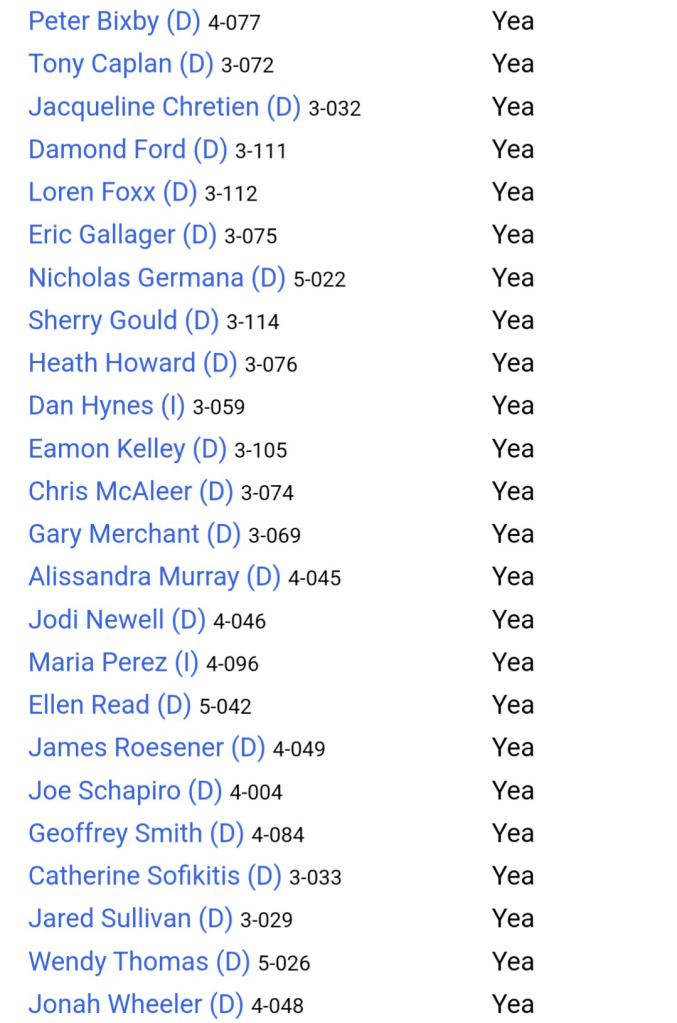
January 4th was a momentous day for anti-war advocates. We passed HB 229, Defend the Guard out of the House! The vote was 187 to 182, incredibly close. We got bipartisan support with 24 Democrats crossing over, proving the anti-war left still exists, and is willing to stand up against the military industrial complex. I thank each and every one you for helping us pass this important bill:
Sadly, 26 Republicans voted in favor of forever wars by opposing the bill, and I wish them luck in their primaries this fall:
The bill initially was assigned to Finance, due to the (bogus) fiscal note attached, and they waived off. It is now headed to the Senate! Please, reach out to your Senator to educate them on this bill.
I want to thank Derek Proulx, regional director for the Defend the Guard organization here in New Hampshire, who spoke in front of GOP and Democrat committees, many VFW and American Legion posts, and has been a rock star whipping support for this bill. I also want to thank the support of the co-sponsors, Matt Santonastaso, Michael Granger, Joshua Adjutant and prime sponsor John Potucek for all the hard work getting this here. I always want to recognize Dianne Pauer for identifying potential issues with the bill and clarifying the language in her floor amendment. And, very importantly, I want to thank Ellen Read and Jonah Wheeler that reached out amongst their caucus to get support from the anti-war Democrats on their side. It was truly moving to see their votes.
Now – onto the Senate!
Floor speech:
Thank you Mr. Speaker.
I rise in support of HB229, commonly referred to as the Defend the Guard Act. This bill, very simply, requires Congress to formally declare war pursuant to Art I Section 8 of the US Constitution before we will deploy our State National Guard to a foreign combat zone. It does not stop training deployments, natural disaster response, use to repel invasion or quell uprisings. It has been filed in 38 states, making progress through legislatures.
The fiscal note attached to this bill, a vague “puts funding at risk” is the same, tired, hollow threat the Feds use to bully states into compliance. It’s intentionally non-committal because it is nonsense. When filed in Kansas, Defend the Guard was reported accurately as having no fiscal impact. Congressmen Gossar and Massie have spoken in favor of this bill, stating Congress controls the purse strings, and no member would consider defunding a Guard unit. It simply would be political suicide to file an amendment to an appropriations bill defunding a single State Guard, being both a petty act of malice and also making the country weaker. It will not happen.
Now, for a bit of history. Congress has not formally declared war since 1942. The War Powers Resolution of 1973 introduced the Authorizations for Use of Military Force (AUMF for short), which have been the mechanisms by which the Presidents have executed military operations ever since. This abdication of a constitutionally delegated power to the Executive Branch ultimately led us to the forever wars of the last 2 decades.
The 2001 AUMF was hastily passed in the wake of 9/11, and was so vastly worded, with vague limits on targets, theater of operation, and no victory conditions that it has been the justification for military action in 22 countries. Over the course of this war on terror, National Guard units made up 45 percent of the boots on the ground in Afghanistan, Iraq, and Syria, accounting for 18 percent of the casualties.
Hurricane Katrina’s devastation in 2005 was exacerbated by Guard soldiers and equipment that were deployed to Iraq and Kuwait instead of at home protecting their communities. Years later, one of the same missing Louisiana National Guard units, the 256th Infantry Brigade, came under rocket attacks during their deployment to Syria in 2021 where the US is occupying that country’s oil fields.
The Pentagon will continue to exploit State Guard units, to bolster their shrinking ranks in these forever wars, until the States say “enough is enough.” Asking people to “vote harder” in federal elections or to beg out Representatives to repeal the AUMFs has been a failing proposition to stop the uniparty war machine for decadesThe most recent vote in the US Senate to repeal the 2001 AUMF garnered only 10 votes. This is in our hands, right now, to protect the lives of the servicemen and women in our state and to ensure our Guard remains always ready, always there. I ask that you stand with them, Defend the Guard, and press the green button for OTP on HB229.
I’ll start with a bit of history on State of Emergency (SoE) Reform this session.
HB127 was the bill I was co-sponsored on that included last term’s SoE language. It left Executive Departments committee with an 11-7 vote to pass. From there, a roll call vote of 193-185 passed it out of the House. The Senate then ran defense for the Governor, with their committee recommending to kill the bill, stating “it does nothing” and unceremoniously allowing it to die on the Senate floor by a cowardly voice vote.
There’s some debate on the excuses, some claiming they believed the text didn’t change current law, and then others claiming they knew the text was included in HB2 so they killed the standalone bill since the Governor would veto. This is a running theme with the Senate – instead of forcing the corner office to bear the shame of vetoing bills that would make him look bad, they find excuses to do his bidding and act as his representation in the Legislature, instead of their constituents’.
Meanwhile, the House stuffed the text of HB127 into the budget trailer bill (HB2) as a safeguard, assuming the standalone bill will once again get vetoed. The budget was a battle in an of itself, but ultimately passed out of the house with a voice vote after the Freedom Caucus attempted, but failed, to correct the massive overspending.
When HB2 arrived in the Senate, the language of HB127 was the first to be struck. This, again, was likely due to the request of the Governor. Thankfully Melissa Blasek at RebuildNH spotted this in the hard-to-follow daily reports on the GenCourt website and notified myself and several other Reps. We immediately took to the phones and contacted Senators Gray and Carson, explaining we would not vote for this budget if SoE was not included.
If @NHSenateGOP doesn't put SoE reform back in the budget, I'm voting "no" when it comes back over.
SoE reform presence doesn't guarantee my "yes" vote, but its absence guarantees my "no" vote.
— Tom Mannion – NH State Rep (@mannion4nh) May 25, 2023
I also took to Twitter.
There was an angry return phone call from Gray where he once again tried to claim the language “does nothing” but as soon as I explained what it changed, he stated the Governor would likely veto the budget if the language was included, meaning Gray knew the language did *something* but assumed I would back off, or was quizzing my knowledge of my own co-sponsorship – not sure which. He said my attitude was brinksmanship, which is true, but some priorities are too important to compromise over.
Barring CoC games and anything egregious being added in the coming week, I'm back on board for the budget.
— Tom Mannion – NH State Rep (@mannion4nh) May 30, 2023
Much to the Governor’s chagrin, I assume.
This brings us to yesterday, June 8th. The Concur motion on the Senate-amended HB2. They did a lot of dancing around with numbers, moving some spending from 2024 into this year by consuming a budget surplus and claiming they cut down the budget by ~$750M by doing so. But the real choice now had to be made: Pass the bloated budget, and take whatever wins from it that we can, or send it to a committee of conference.
If the bill went to committee of conference due to Republicans not getting on board, the Senate would absolutely strip SoE as the first order of business as a “well, we gave you what you wanted, but it wasn’t enough, so now you get nothing” retribution. They’d also add in a bunch of junk to win over the solid voting block of the Dems, meaning the bad budget would only get worse. My choice was to pass the budget and get a few wins in HB2, to include SoE Reform, faster Interest and Dividends tax phase out, minor occupational licensing reform, and an alert system to Federal checkpoints.
The budget ultimately passed with a resounding super majority of 326-52. Coupled with the unanimous 24-0 vote from the Senate, any veto from the Governor will be overturned. I campaigned on SoE reform, and the path was rocky, but we’re going to get there.
In a 193-185 Roll Call vote, State of Emergency Reform passed the house on 3/22/2023. I am a cosponsor on this, alongside many liberty heavy-hitters, with Tony Lekas as prime sponsor.
This was one of the key components of my campaign to run for office. I moved from Massachusetts to escape lockdowns in 2020. I saw what an unrestrained executive branch could do, and was very disappointed when last term’s version of this bill was vetoed despite the governor’s promise of a signature.
The bill now has two paths forward: either down the same route as last term, with a likely veto, or incorporated as part of HB2 in the budget trailer bill. I made it clear in a whipping question that I would like to see HB127 incorporated as part of the budget to ensure the governor’s signature. As a freshman representative, it’s likely my threat to vote “no” on the budget over this would not hold a lot of weight, but I’m certain I am not alone on this issue.
State Representative – Hillsborough County District 01 (Pelham)


 Tom Mannion for New Hampshire