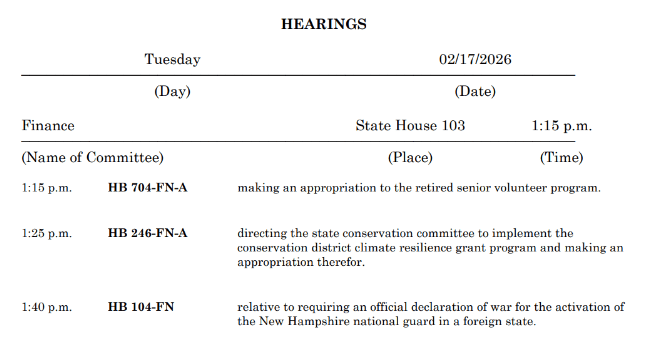
Hearing Alert – HB104 Defend the Guard

At first we failed to pass HB1, requiring us to table HB2, then had to pass a continuing resolution (CR) to keep the government operational for 6 months. Had that been our final path, the budget would be a Senate + House Democrat written budget, since it became obvious that a small faction of the Republican Party could not be reasoned with. While the debate for the CR occurred, several members were whipped to flip their vote, one of those members negotiated with House leadership to address a big ask he made made for the budget since day 1, and will now have the backing of the Majority Office behind his cause (talk about negotiation skills!) I also intend to work with those that voted “no” on legislation next year to address their concerns, because I agree that there’s always room for improvement!
We reconsidered the failed vote on HB1, and it passed by 5 votes. We removed HB2 from the table, moved the question (skipping 9 speeches that would not change the outcome), and passed it by the Speaker’s tie-breaking vote!
Now, things that made are in the budget that will be signed by Ayotte:
All of this occurred without increasing or creating any new taxes, despite the wishes of the Democrats and some bills filed by the Senate.
I’m pleased to announce HB230 – relative to the adoption of public health ordinances by municipalities was signed by the Governor!
I co-sponsored this legislation to fix flaws that were exposed during COVID tyranny.
This is a bill designed to reign in health officers that took it upon themselves to impose mandates outside of their scope.
Thank you Mr. Chair, members of the committee. For the record, I’m Tom Mannion, representing Hillsborough 1 – Pelham. I’m also a United States Marine Corps Infantry combat veteran that deployed twice to Iraq. It was my experiences there that motivated me to learn about US foreign policy, and got me interested in politics. When I first heard about this bill last term, it was entirely within that wheelhouse, and I’m happy to bring it before this committee this term.
HB104, known as the Defend the Guard Act, will prevent the New Hampshire National Guard from being deployed to a combat zone without a formal declaration of war issued by Congress pursuant to Article I, Section 8 of the United States Constitution. I believe this premise is one just about all of us can all agree with, so I’ll focus on attacking the fiscal note.
Firstly, it mentions Federal funding may be put at “risk.” Which is intentionally non-committal language, and after a term here in Concord, I’ve heard in many other committees with regards to health mandates, education policy, vehicle inspections, you name it. Whenever the legislature files a bill the executive doesn’t like, they always like to roll out the ol’ “federal money” defense to try and stop it. Congress writes the checks, and no congressperson is going to commit political suicide by defunding a state guard unit, especially with Senator Shaheen on the committee. Both Congressmen Gossar of AZ and Massie of KY have affirmed that no member of Congress will defund any state guard when asked about this bill. I’ll be closing with more on this, but bear with me.
Secondly, the fiscal note mentions what is known as the Montgomery Amendment of 10 USC 12301 (f) which states “The consent of a Governor described in subsections (b) and (d) may not be withheld … because of any objection to the location, purpose, type, or schedule of such active duty.” We are not objecting on any of those grounds, we are objecting on the Constitutionality of the deployment. If the purpose of the Montgomery amendment was to completely remove Governor consent, then subsections (b) and (d) would have been amended to remove the consent requirement entirely. Would anyone here argue that Governor Newsom could withhold consent on the grounds that his state is in crisis?
Next, the fiscal note reads “[Title] 32 USC §108 states “If, within a time fixed by the President, a State fails to comply with a requirement of this title, or a regulation prescribed under this title, the National Guard of that State is barred, in whole or in part, as the President may prescribe, from receiving money or any other aid, benefit, or privilege authorized by law.” We are not prohibiting any Title 32 activation. The section says “under this title” twice, meaning specifically Title 32 activation. Title 10 has no such provision.
Now – AUMFs. Authorizations for Use of Military Force are the very mechanism we are challenging with this legislation. Congress has ceded its Constitutional authority over war declarations to the Executive Branch, without a Constitutional Amendment to do so. As such, the President has been granted powers our founders warned against when they specifically vested the power to declare war with Congress. The fiscal note correctly points out that we have not formally declared war since 1941. Opponents will say “we need the freedom to act quickly!” We, as New Hampshire, have no say in what that President can do with active duty military forces, who will be first to fight. We are simply interceding between the President and our Guardsmen, requiring him to first go to Congress for a formal declaration of war before he can take our sons and daughters, our grandchildren, and our neighbors into that fight.
I want to add that the specific citing of the 2001 AUMF as justification for our military misadventures is particularly absurd. The war in Syria that we helped instigate and have been supporting for a decade, has resulted in the overthrow of Bashar al Assad, and the installing of Abu Mohammed al-Jolani as de facto leader. This man was a member of Al’Qaida in Iraq, the insurgency that came to the country to shoot at guys like me. He later folded into ISIS and then back out into various factions of al-Qaeda in Syria, and until a few weeks ago, had a $10M bounty from the US on his head for his terrorist activities. National Guardsmen have been attacked because of this conflict. In 2023, the Lousianna Guard came under rocket attacks in Northeastern Syria while defending oil fields, and last year Tower 22 in Joran, right over the borders of Iraq and Syria, came under drone attack that resulted in 3 Army Reservists from GA being killed, along with 41 National Guardsmen being wounded from AZ, CA, KY, and NY. And, it is my understanding through the Lance Corporal underground, that the NH National Guard had returned home from that base only weeks prior to the attack. It could have easily been our guys coming home in boxes.
In closing, the most important development has occurred since we passed Defend the Guard out of the House last year: the nomination of Pete Hegseth for Secretary of Defense. A few days after we took that bipartisan vote, Hegseth said this on Fox and Friends:
“New Hampshire is simply pointing out that it’s supposed to be Congress that declares war. It has become an executive branch function, and as a result, unless Congress declares war, New Hampshire doesn’t have to send troops for foreign wars. To me it makes a lot of sense… I love this idea.” It’s my understanding he has since intensified his support for the bill, so the funding fears are more unfounded than ever before, when the guy in charge of the DoD supports this bill.
And with that, I’m open to any questions.
Thank Mr. Chair, members of the committee. For the record, my name is Tom Mannion, representing Hillsborough 1, Pelham. I’m a United State Marine Corps infantry combat veteran with two deployments to Iraq.
Current RSA precludes individuals from being employed by, or achieving higher education in this state without first registering for selective service with the Federal government. I have not found any information suggesting we are financially compensated for enforcing this, unlike most other federal laws/programs that the states cooperate with the feds in enforcing. It should be noted there is no fiscal note. In addition, with regards to higher education, as of 2025, the Free Application for Federal Student Aid (FAFSA) has removed its own requirement that applicants be registered with the draft to apply for federal school loans.
As with many private sector industries, the state is having trouble filling many roles. We have a bill right now to form a study committee to look into the problems with hiring law enforcement. The Selective Service Compliance Act is a hindrance in this process. We limit the talent pool, unnecessarily, by putting hurdles in our own way.
The Federal government already has steep penalties should someone fail to comply with the draft, should it be started up again, it doesn’t make sense to me that we, as a State, put ourselves and our citizens at a disadvantage when the draft has not been active for 50 years.
I ask that you vote OTP on HB55 and with that I’m happy to take any questions.
My 3rd and final prime-sponsored bill has been scheduled for Tuesday, January 21st at 1pm in room 301 at the Legislative Office Building in Concord!
This bill simply removes the ability for cities and towns to seize your dog for failure to pay a license fee. It does NOT remove licenses, nor fines, nor the ability for towns to refer the issue to the court system to force payment.

The heavy-hitting Defend the Guard is already scheduled for a hearing, Friday January 17 at 1:30pm at the Legislative Office Building in Concord NH, Room 206! Preceding that is my bill to prune out Selective Service Compliance Act from RSA at 1pm. If you can make it, please show up to testify!
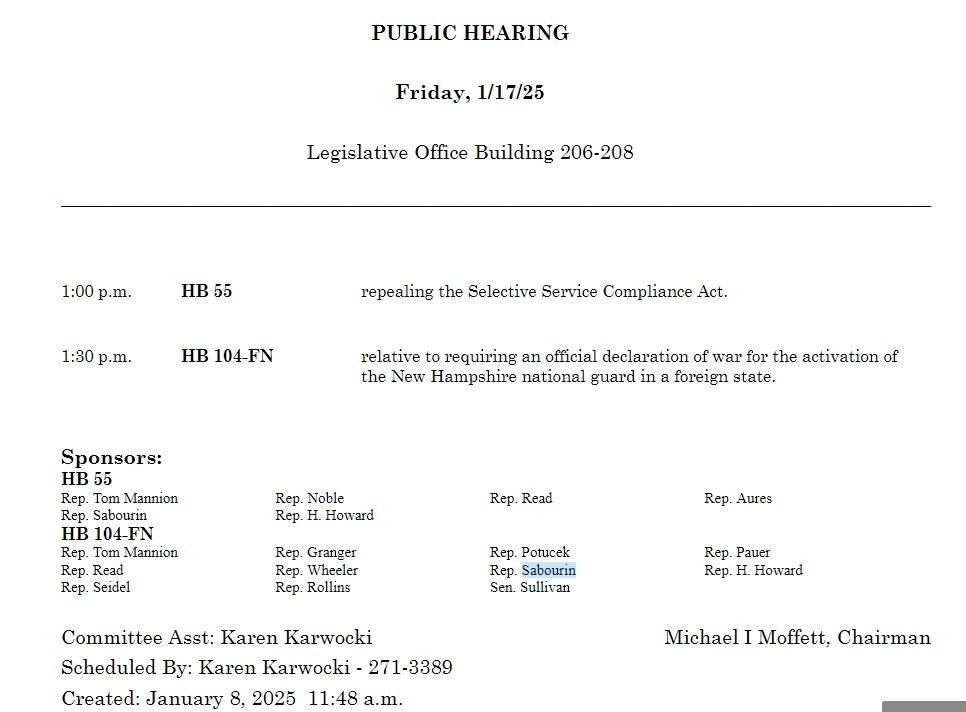
Similar to HB1338 from last session, I filed the repeal of New Hampshire’s Selective Service Compliance Act. The current law forbids individuals from enrolling in college, or receiving financial assistance for that education, or ever being permitted to be employed by the state in any capacity unless they have registered in compliance with the Federal Selective Service Act.
As an Iraq war combat veteran, I’ve become incredibly skeptical of United States’ foreign policy of the last several decades – between destabilization of Iraq, Syria, Yemen, and Libya, and the disregard for the lives of the Ukrainian and Russian conscripts dying for a proxy war at the behest of the military industrial complex puppet masters behind the Biden administration, and of course the 20-year occupation of Afghanistan that ultimately resulted in thousands of lives lost to transfer the country from the Taliban to the Taliban.
I no longer trust that bringing forth the draft would be in the best interests of the United States, especially at the expense of the lives of the next generation, and I will not allow New Hampshire to be a facilitator through coercion with the existing compliance act.
And from a federalism standpoint, it is simply not the role of New Hampshire to be enforcing Federal law. As such, I have filed a repeal of the existing statute.
Thank you Mr. Chair, members of the committee. I’m Representative Tom Mannion, representing the town of Pelham. I’m also a United State Marine Corps Infantry Veteran, where I deployed with 3rd Battalion, 6th Marines to two combat deployments in Iraq. It was my experiences there that got me paying closer attention to politics, especially foreign policy, and put me on the path that brought me before you today.
My deployment in 2005 overlapped with Hurricane Katrina. A fellow squad mate, and eventual purple heart recipient, was from New Orleans. I couldn’t imagine what he was going through, knowing his family was trapped in rising flood waters, a world away and having to stay focused on patrol. What we didn’t learn until much later is how the war we were fighting contributed to the unnecessary loss of life back home.
During Katrina, 35% of Louisiana’s National Guard was in Iraq. Civil engineering equipment, supplies, and even helicopters from Louisiana and Mississippi Guard units were deployed to Iraq and Kuwait, and were unavailable for rescue operations. The call reached out to other states, whose Guard units were also deployed, prepping for deployment, or just returning from deployment to come aid. The DoD was forced to tap active duty Army and Marine Corps units to fill the gaps in the missing Guardsmen, but their slow deployments had fatal consequences. Former FEMA director Gen. Julius Becton Jr. said “If the 1st Cav. and 82nd Airborne had gotten there on time, I think we would have saved some lives.” But the reality is, the Louisiana Guard should have been available to their State in the first place.
That same missing Guard unit, the 256th Infantry Brigade Combat Team, was on the receiving end of rocket attacks in Syria in 2022. Which brings me Authorizations for Use of Military Force. They were implemented after the Vietnam war as part of the War Powers Act, and are the mechanism by which the United States has conducted combat operations across the globe ever since. The problem is, they lack the formality and the political consequences of a formal declaration war as defined by Art I Section 8 of the US Constitution. It has become a way for Congress to release itself from responsibility for these disastrous conflicts, while granting near limitless power to the Executive without a proper Constitutional amendment to do so.
In 2013, Congress abandoned the idea of issuing a new AUMF for Syria, as they knew how politically unpopular the forever wars in the Middle East have been. However, the Obama administration, and all those to follow, have cited the 2001 AUMF for GWOT and the 2002 AUMF for liberation and protection of Iraq as “good enough” legally to execute our war against ISIS and training of militants for regime change against Bashar al’Assad. Attempts to terminate these AUMFs have failed repeatedly, with Senator Rand Paul’s last bill only garnering 10 votes in the Senate. Asking the Federal Delegation is a failed proposition.
In more recent history, and as further spill-over from the endless Iraq and Syrian conflicts, the Tower 22 base in Jordan was attacked by Iraqi militia In January of this year, killing 3 soldiers and wounding more than 40 others. Among those were several Arizona National Guardsmen. It should come as no surprise then, that the Arizona Senate passed Defend the Guard, with every member of their Military Affairs and Public Safety Committee as a co-sponsor. They believe the guard would be better served securing their southern border instead of forward deployed in harms’ way for no benefit of the United States. I also heard through the Lance Corporal underground, as we used to call it, that our own Guardsmen had been deployed to that exact same base a few years back. When I asked the Deputy Adjutant General to confirm, he could not comment due to operational security reasons.
Finally, I want to address the other fatal consequences these deployments have. The suicide rates among post-9/11 veterans is horrifying, 4x higher than the casualties from combat itself. A lot of platitudes and useless talk is done by politicians in front of cameras, but no one wants to make the bold move necessary to destroy the root cause. The Pentagon is deploying our young men and women into combat zones with no objective, no clear targets, no victory condition, no end in sight. We lost thousands of lives in Iraq, only to pull out and have huge chunks of the country immediately fall to ISIS, requiring us to return and sit around at bases getting shot at, STILL with no exit strategy. We spent twenty years and thousands more lives transferring Afghanistan from the Taliban, back to the Taliban. These abysmal failures weigh on the minds of the men, like me, that watched their squad mates die, ultimately for nothing. We are no better off as a nation, no safer whatsoever from these sacrifices. And Congress will never change course until individuals like us, at the state level, force them to.
Please, as a combat veteran of these pointless conflicts, with invisible scars of my own, I ask that you vote OTP on HB229, and protect our State’s service members from the exploitation of DC. I’m happy to take any questions.
Defend the Guard has its Senate hearing scheduled:
Tuesday, April 9, 2pm
State House Room 103
Concord, NH
We need all hands on deck. GWOT Veterans come with stories about your service.

 Tom Mannion for New Hampshire